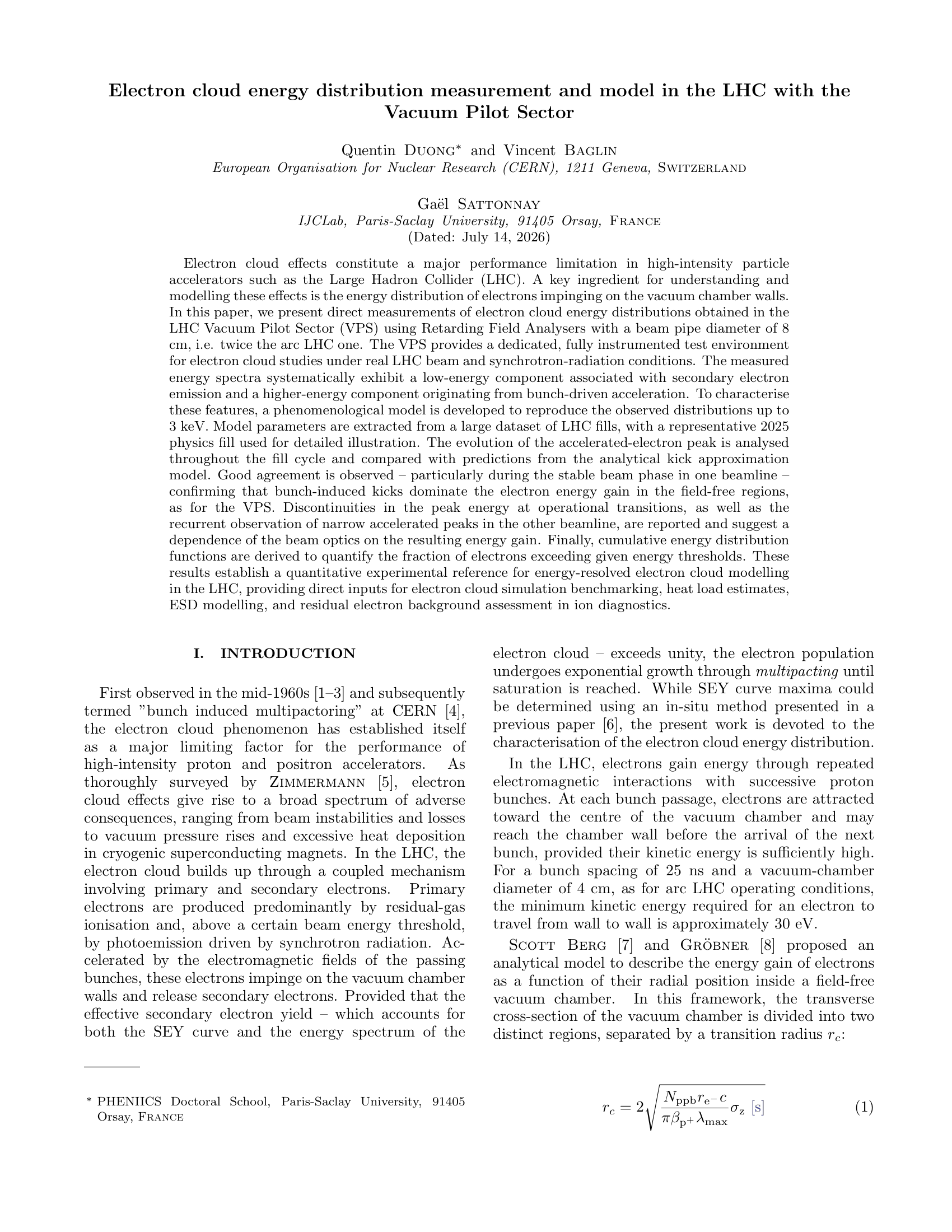
Electron cloud energy distribution measurement and model in the LHC with the Vacuum Pilot Sector
Physical Review Accelerators and Beams
August 2026
Physical Review Accelerators and Beams
August 2026
Physical Review Accelerators and Beams
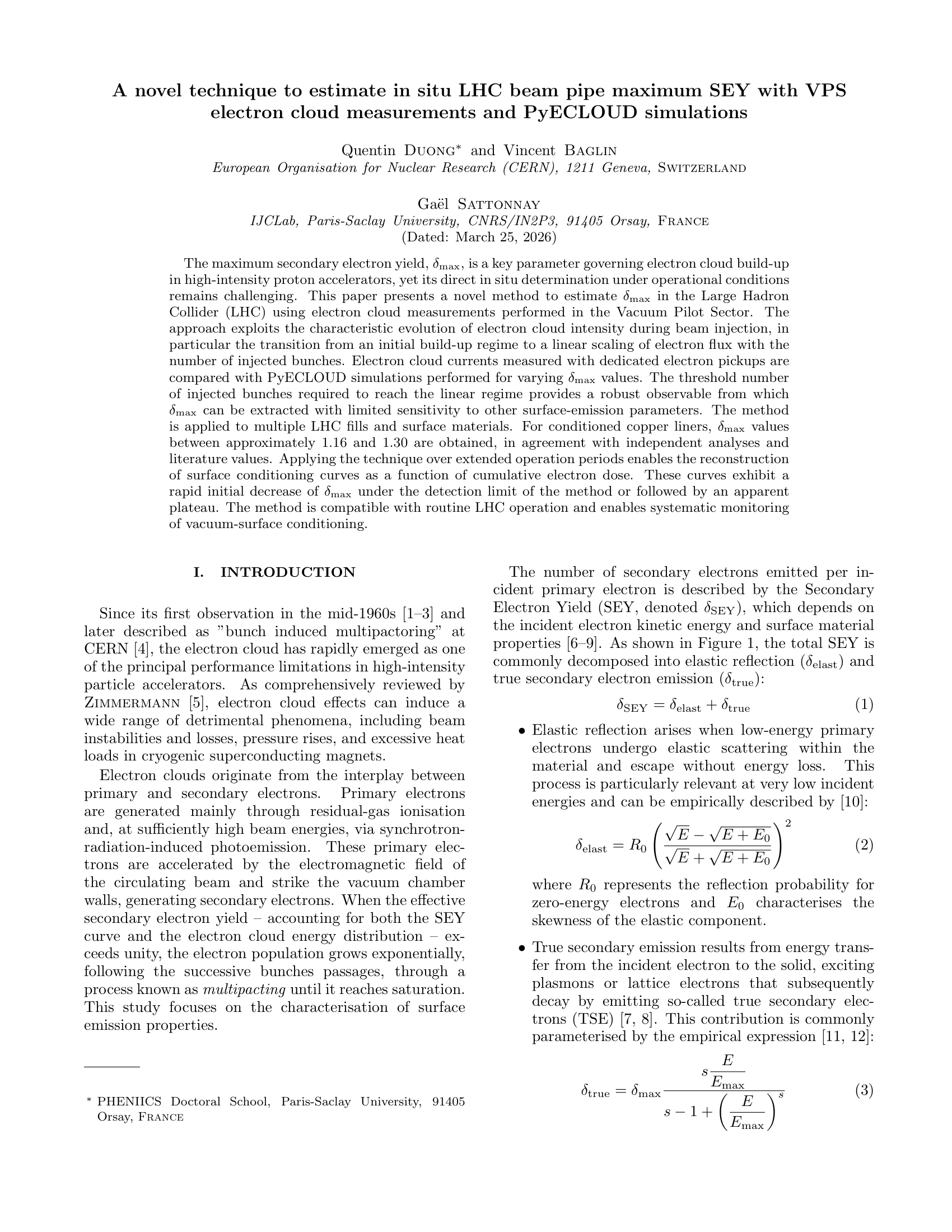
The maximum secondary electron yield, $\delta_\mathrm{max}$, is a key parameter governing electron cloud build-up in high-intensity proton accelerators, yet its direct in situ determination under operational conditions remains challenging. This paper presents a novel method to estimate $\delta_\mathrm{max}$ in the Large Hadron Collider (LHC) using electron cloud measurements performed in the Vacuum Pilot Sector. The approach exploits the characteristic evolution of electron cloud intensity during beam injection, in particular the transition from an initial build-up regime to a linear scaling of electron flux with the number of injected bunches. Electron cloud currents measured with dedicated electron pickups are compared with PyECLOUD simulations performed for varying $\delta_\mathrm{max}$ values. The threshold number of injected bunches required to reach the linear regime provides a robust observable from which $\delta_\mathrm{max}$ can be extracted with limited sensitivity to other surface-emission parameters.The method is applied to multiple LHC fills and surface materials. For conditioned copper liners, $\delta_\mathrm{max}$ values between approximately 1.16 and 1.30 are obtained, in agreement with independent analyses and literature values. Applying the technique over extended operation periods enables the reconstruction of surface conditioning curves as a function of cumulative electron dose. These curves show a rapid initial decrease in $\delta_\mathrm{max}$ before approaching an apparent plateau, which may lie below the detection limit of the method depending on the beam pipe material and location. These curves show a rapid initial decrease in $\delta_\mathrm{max}$ before approaching an apparent plateau, which may lie below the detection limit of the method depending on the beam pipe material and location. The method is compatible with routine LHC operation and enables systematic monitoring of vacuum-surface conditioning.
PhD Thesis · Université Paris-Saclay
December 2025
Context. Electron clouds $-$ generated by synchrotron radiation,
residual-gas ionisation and
secondary electron emission $-$ limit the performance of high-intensity accelerators. At the LHC,
they induce pressure rises, transverse instabilities and heat loads on superconducting magnets,
reducing luminosity. Their understanding and mitigation are crucial for the LHC, HL-LHC and future
projects.
Method. This thesis exploits the Vacuum Pilot Sector (VPS, LSS8),
combining photon,
electron, gas and calorimetric diagnostics to measure photoemission, multipacting, energy spectra,
desorption and electron-induced heating. A full calibration and analysis chain, coupled with
PyECLOUD simulations, was developed to interpret Run 3 measurements and extract effective surface
parameters comparable with laboratory data.
Results. Primary electron generation is dominated by photoemission at
LHC energies, but
photon flux strongly depends on beamline geometry. Materials show distinct behaviours: amorphous
carbon efficiently suppresses multipacting, NEG coatings also reduce residual gas, while copper
exhibits the highest electron activity but strong conditioning
($\delta_\mathrm{true}^{\mathrm{max}}\approx$1.2-1.3). Differences are observed between stations
of the same material, linked to synchrotron exposure and conditioning history, highlighting the
heterogeneous nature of cloud dynamics. Energy spectra reveal that $\sim$50% of electrons have
$<$140 eV and $\sim$95% $<$1400 eV, with two peaks corresponding to secondary electrons
(low-energy, stable) and beam-accelerated electrons ($\sim$200 eV, intensity- and
orbit-dependent). No ion densities above residual-gas predictions ($\sim$fA.cm$^{-2}$) were
detected. Heating estimation reaches a few W/m in copper, imposing a constraint on cryogenic
margins; yet, calorimetric data couldn't clearly confirm or infirm those.
Contributions & Outlook. This thesis establishes an integrated VPS
analysis framework
and an operational method to extract $\delta_\mathrm{true}^{\mathrm{max}}$. The results benchmark
and refine simulations, highlight material influence, and clarify electron cloud heterogeneity.
They provide guidance for HL-LHC optimisation and offer a transferable methodology for future
high-intensity accelerators (coatings and filling schemes).